More about Suprime-Cam
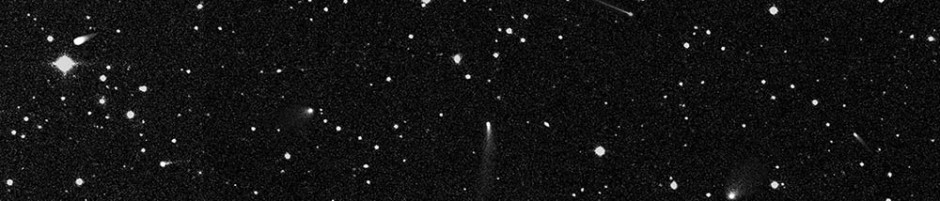
Today, I thought I’d give you a different view of the camera and images that you currently see on Comet Hunters. Right now we’re showing archival images of asteroids from the Subaru Telescope with Suprime-Cam.
Suprime-Cam can image a 0.25 of a square degree patch of sky in a single observation, that’s a bit bigger than the size of the full moon as viewed from Earth. Until a few years ago with the first light of its successor instrument, Hyper-Suprime-Cam, Suprime-Cam reigned as the largest field-of-view camera on the 8-10-m class telescopes,currently the largest ground-based telescopes. Suprime-Cam is an 80-mega pixel camera weighing in at 650 pounds and located at the prime focus of the Subaru Telescope. You can learn about the camera first light and commissioning here and about the upgrade of the camera is 2008 here.
Suprime-Cam is equipped with 10 CCDs (charged coupled devices) that actually receive the photons and and are read out to produce the images we show on Comet Hunters. Subaru has two rows of 5 CCDs. You can rotate the direction of the camera as well. If you display all 10 CCDs from a single observation it looks something like this if you have the widest part of the camera along the East-West direction (for Right Ascension). If the full moon was imaged it would fill most of the imaging plane:
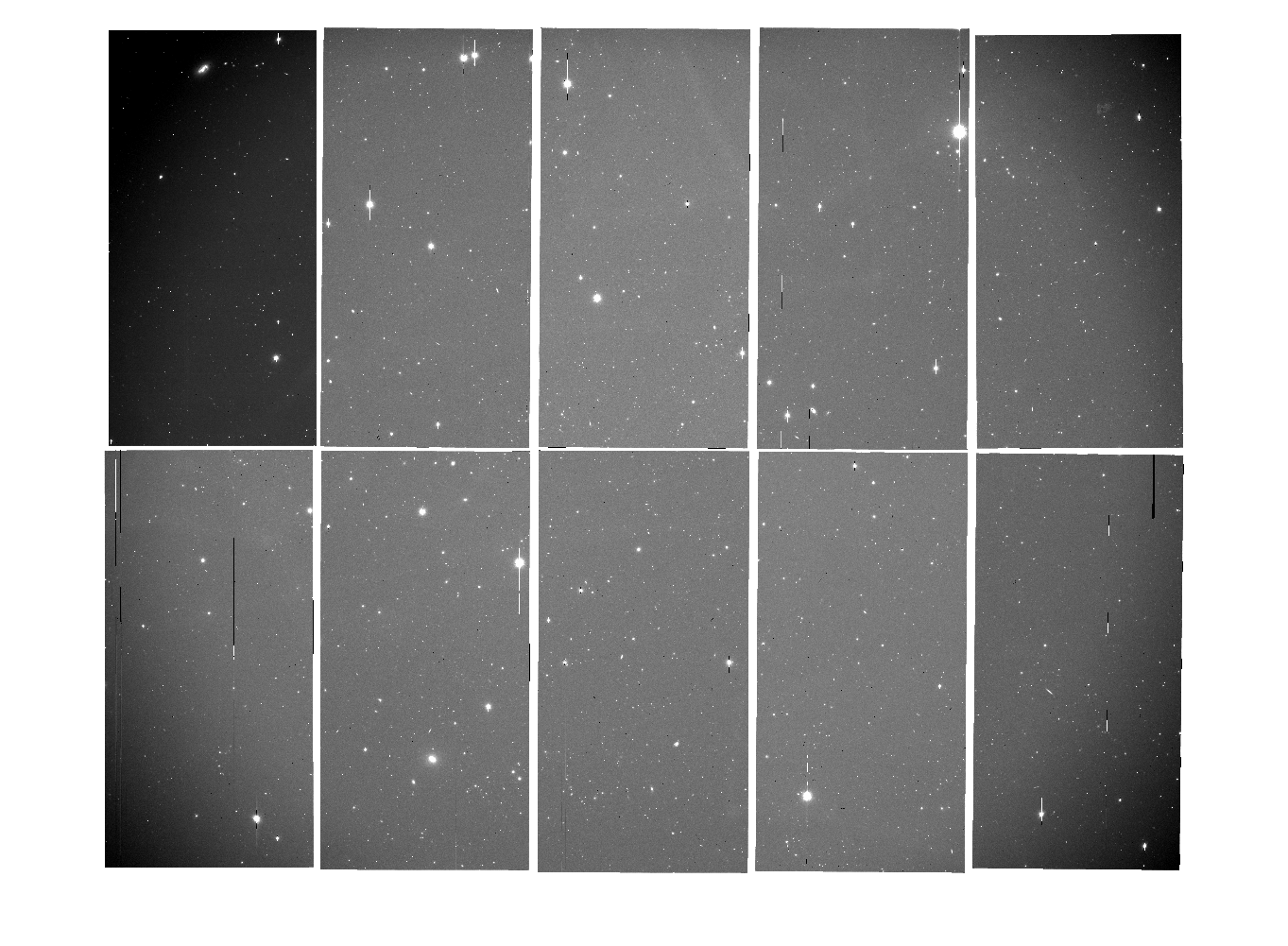 You can see the different CCDs and amplifiers that read out the electrons trapped in the CCD’s wells are slightly different from each other as well as the effects of how light travels through Subaru’s optics. We can take all of that out with calibration observations (flat field observations, dark and bias images). This image is pretty much a raw image off the telescope. The white lines in a grid are the small gaps/boundaries between each of the different CCDs. Let’s zoom in a bit further between the two center CCDs so you can get a better view:
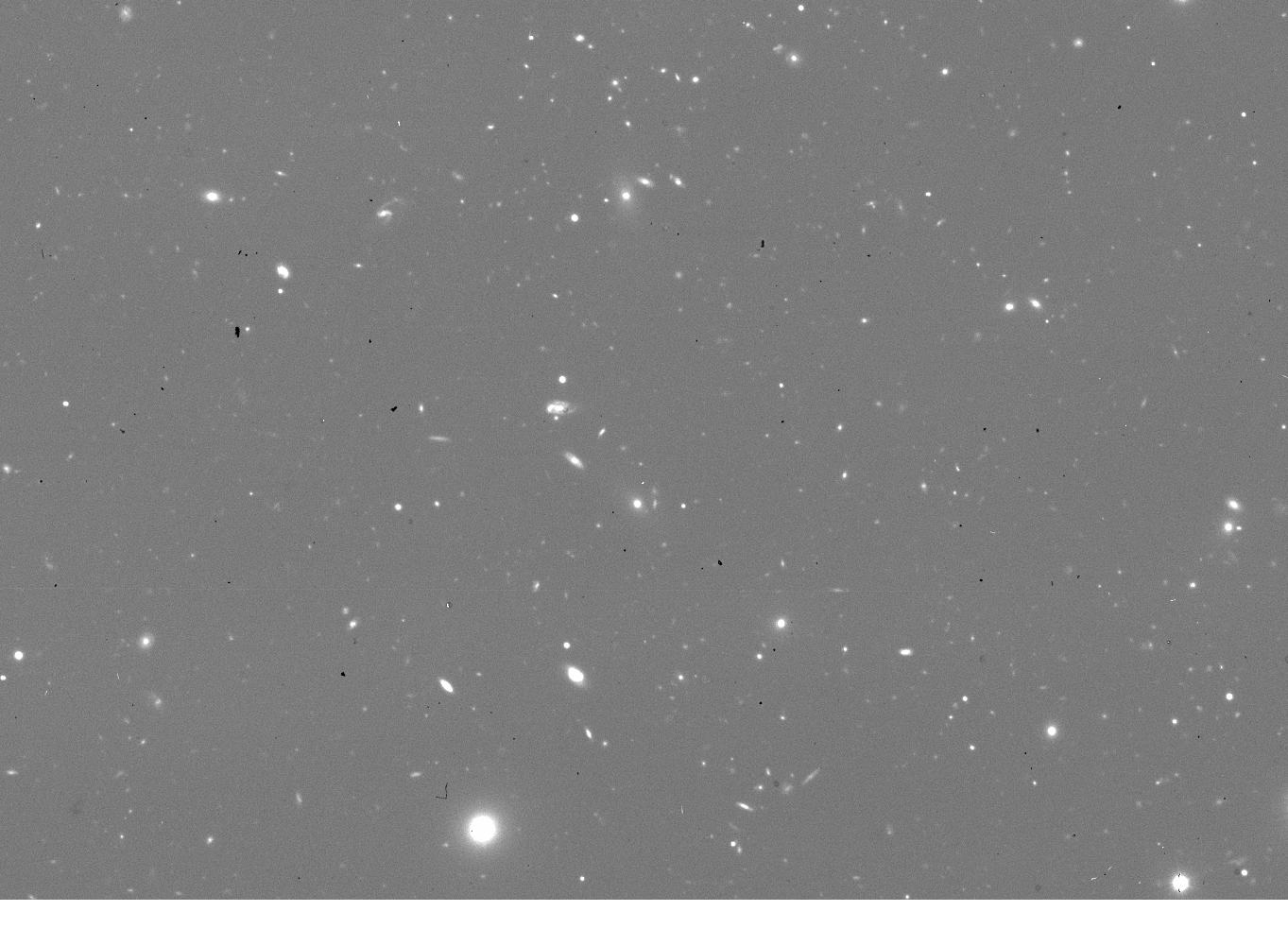
 Now (in the above image) you can start to see how many stars are on each of those CCDs. And if we keep zooming in…
 We show a much more zoomed in image on Comet Hunters focused very close around the asteroid and reference stars.
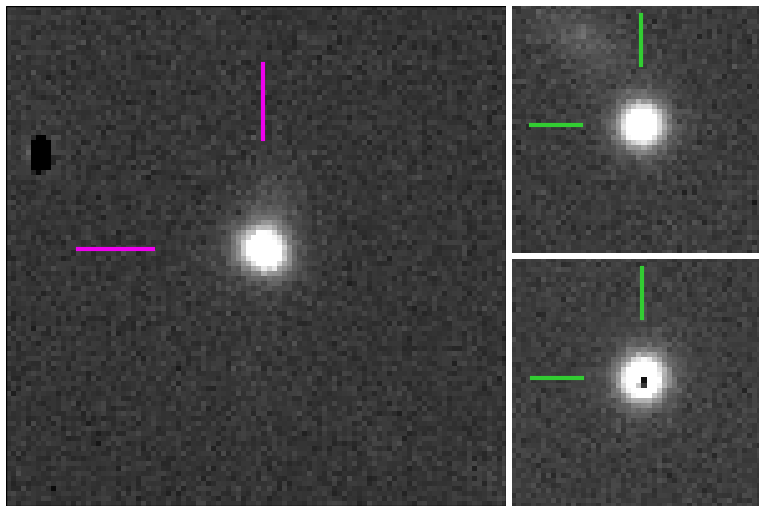
The width and height is 20 arcseconds (100 pixels) for the bigger image on the left (the asteroid image) . On the right, two little reference star subimages are ~10 arcseconds (50 pixels) for the size. For a sense of scale each of the 10 Subaru CCDs are about 2048 x 4096 pixels
Meet the Team: Henry Hsieh
Today we have the next post in our Meet the Comet Hunters Team series. This time we’re focusing on principal investigator (PI) of Comet Hunters, Henry Hsieh.

Name: Henry Hsieh
What is your current position and where/institution?
Research Scientist with the Planetary Science Institute, living in Honolulu, Hawaii
Where are you originally from/where did you grow up?
New Jersey, USA
What is your role in Comet Hunters?
PI
Beyond Comet Hunters, what else do you work on?
Besides Comet Hunters, I also work on other main-belt comet and disrupted asteroid research including targeted observational analysis to understand their physical properties, dynamical analyses to understand their orbital evolution, and exploring different ways to discover more.
In 3 lines explain your PhD thesis?
I did the first in-depth observational analysis of the first discovered main-belt comet, 133P/Elst-Pizarro (although the term “main-belt comet” did not yet exist at the time). I then performed a targeted observational search for more “Elst-Pizarros”, the success of which led to the recognition of main-belt comets as a new class of comets.
Why are you interested in main-belt comets?
Besides being the topic of my PhD dissertation, main-belt comet research is extremely new and so has many opportunities to make new discoveries. It also has very interesting implications for understanding the formation of our solar system and maybe even the origin of water, and therefore life, on Earth itself.
Name one hobby of yours?
Free diving
What is the most recent tv show you have watched?
Mr. Robot
What is your favorite movie?
Gattaca
What’s one thing most people don’t know about you?
I have used telescopes on every continent (including Antarctica) except for Australia.
Favorite cocktail or beverage?
Guinness
Meet the Team: Kiwi Zhang
Today we have our next in our Meet the Comet Hunters Team series.
Name: Kiwi Zhang
What is your current position and where/institution?
Project Support Engineer/Scientist at Academia Sinica Institute of Astronomy and Astrophysics (ASIAA)
Where are you originally from/where did you grow up?
Taipei, Taiwan
What is your role in Comet Hunters?
Develop the Subaru image analysis pipeline
Beyond Comet Hunters, what else do you work on?
Work on the Trans-Neptunian Automated Occultation Survey (TAOS) project for developing control software
In 3 lines explain your PhD thesis?
Developed an analysis pipeline to process the image data and to detect the candidate events produced by the occultation by Trans-Neptunian Objects (TNOs)
Why are you interested in main-belt comets?
They are a mystery group in the Main Belt.
Name one hobby of yours?
Programming
What is the most recent tv show you have watched?
The Wired
What is the latest book you have read?
The Devotion of Suspect X by Keigo Higashino
Divergent trilogy by Veronica Roth
What is your favorite band/music artist?
Sodagreen/Taiwan
Favorite cocktail or beverage?
Beer in general except STOUT
Meet the Comet Hunters Team: Ying-Tung (Charles) Chen
Today we have our first in the series of Meet the Comet Hunters Team posts to help you get know the people behind Comet Hunters better. Ying-Tung (Charles) Chen from the Science Team is kicking off the series.

Name: Ying-Tung (Charles) Chen
What is your current position and where/institution?
Postdoctoral researcher at Academia Sinica Institute of Astronomy and Astrophysics (ASIAA)
Where are you originally from/where did you grow up?
Taiwan
What is your role in Comet Hunters?
Preparing Subaru Hyper Suprime-Cam (HSC) image for next stage of Comet Hunters.
Beyond Comet Hunters, what else do you work on?
Outer solar system dynamic (beyond Jupiter), like Kuiper Belt objects and Centaurs
In 3 lines explain your PhD thesis?
To Search for unknown distant objects in outer solar system.
To investigate dynamic and physical properties of Kuiper Belt objects.
To understand the ice world at edge of outer solar system<
Why are you interested in main-belt comets?
Main-belt comets is an unknown/new subject in inner solar system. It is quite interesting to understand why it has a cometary activity.
Name one hobby of yours?
Rock Climbing
What is the most recent tv show you have watched?
Agents of S.H.I.E.L.D.
What is your favorite movie?
Life of Pi
What is the latest book you have read?
The Demographic Cliff: How to Survive and Prosper During the Great Deflation of 2014-2019 by Harry S. Dent
Who is your favorite singer/band/musical artist?
Vienna Teng
What are five of the top ten most played songs on your iTunes/spotify/etc playlist?
地平線の向こう側へ/Misia
Dear Tokyo/SID</div>
Rat A Tat/Fall Out Boy
Bed of lies/Matchbox Twenty
千本桜/和楽器バンド
What’s one thing most people don’t know about you?
Well cooking on Taiwanese cuisine.
Favorite cocktail or beverage?
Talisker
Comet Hunters at the American Geophysical Union Meeting
Comet Hunters Principal Investigator (PI) Henry Hsieh was at the the American Geophysical Union (AGU) Fall Meeting in San Francisco where on Friday he gave a talk on ‘The Reactivation of Main-Belt Comet 324P/La Sagra’ and gave Comet Hunters a shout out in his talk, announcing the project for the first time to the planetary science community. AGU is the largest gathering Henry’s slide is below:

How the Images Were Obtained: Observing at Subaru
The images that we show on Comet Hunters come form the Subaru Telescope and currently the Suprime-Cam wide-field imager, which Charles described in the last blog post. We are using images primarily taken for other purposes that serendipitously have known asteroids in the images. Since most of the science cases that prompted those observations were likely about other things outside our the Solar System, most of these asteroids have gone unnoticed and never been looked at for cometary activity.
Subaru is mostly a classical observing telescope, which means you apply for time on the telescope and if the Time Allocation Committee (TAC) awards your proposal time on the telescope you have to go to Hawaii or to a remote observing station and take the observations. Of course this is not completely on your own you have help from the telescope operator who’s job it is to run and drive the telescope. On my observing runs at Subaru there has also been an observatory staff scientist who is an expert on Suprime-Cam there for additional support. It is the visiting astronomers’ jobs to decide where the telescope is pointing, how long the camera should be imaging, and what filter should be on the imager. The visiting astronomers are also checking the image quality and determining if it is good enough for their science requirements. If it isn’t they can ask for the telescope to be refocused to try and improve the crispness of the stars in image (or the size and shape of the point spread function).
Although there are remote observing stations in Japan and in Hilo, Hawaii most observations are taken at the telescope. Well in reality right next door to the telescope near the top of Mauna Kea. Telescope is housed in one building with the telescope control room in the building next door connected by a tunnel. Mauna Kea reaches 14,000 feet above sea level where it is possible to get altitude sickness, which can be very serious. Observers from the summit are barred from deep sea diving right afterwards and vice versa because it would cause ‘the bends’ or decompression sickness.
You can definitely feel the lack of oxygen and the dryness of the air when observing there. I was eating a sandwich once while observing on Subaru, and a glitch happened with the camera. I put my sandwich down to help deal with the issue and make sure we were imaging the observation that screwed up after we power-cycled (aka rebooted) the Suprime-Cam. It took about 20 minutes until everything was back running smoothly. By the time I got back to my computer and my night lunch, the bread had given all its water to the air and was stale!
At such high altitudes, there is actually a rule that anyone working at the summit of Mauna Kea cannot stay up longer there longer than 14 hours, before they need to descend to mid-altitude for safety and health precautions. The astronomers, operators, and observatory support staff working on the telescopes at Mauna Kea sleep at the mid-altitude site known as Hale Pohaku (which means ‘stone house’ in Hawaiian), dubbed HP for short by many. Shortly before sunset, the night crews and visiting observers drive up to the telescopes at the summit. At sunrise, or shortly after depending on what wavelength you are observing in, the domes empty out and people descend to mid-altitude for sleep and maybe breakfast. The day crews take over with the engineers and observatory staff scientists perform maintenance, test the telescope and instruments, and prepare the observatory for the next night of observing. One of the moments I look forward to after a few nights observing on Mauna Kea is coming down after a good night of observing to HP and having a warm breakfast while tired and groggy before trying to catch some sleep before the start of the the next night.
Mauna Kea is one of the best astronomical observing sites in the world, and I would say every observational astronomer dreams of one day observing with the telescopes there. We’re all grateful for the privilege and opportunity to use these telescopes on such a special place in the world. In a way, with Comet Hunters we’re extending the scientific legacy of the Subaru Telescope and these observations by searching them for new main-belt comets that might have been hiding in plain sight.
I’ll leave you with some photos below of Subaru and Mauna Kea from my fairly cloudy observing run this past June.


 Comet Hunters Blog